Full prompt
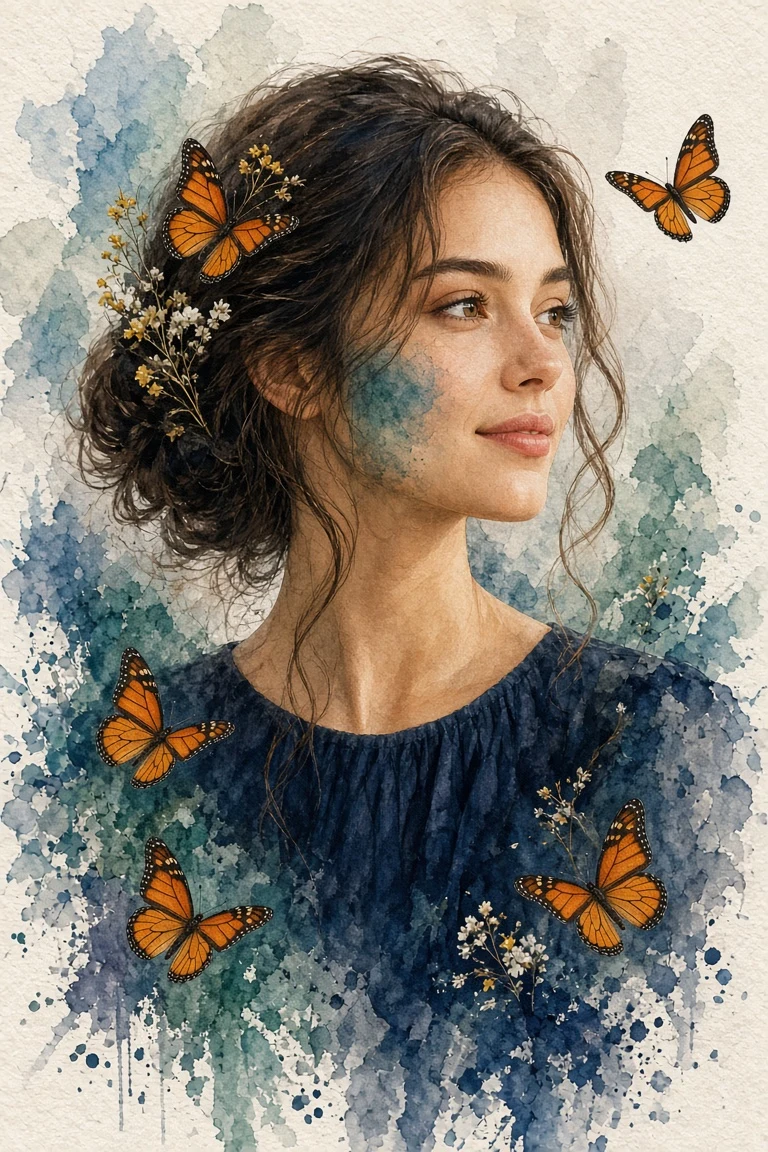
Create a 2:3 vertical premium mixed-media watercolor portrait on off-white cold-pressed watercolor paper.
Use the uploaded image only as the subject reference. Preserve the subject’s natural features, overall appearance, and recognizable look; do not turn the subject into a generic painted character.
Show the subject in a bust-length three-quarter profile, facing slightly toward the viewer’s right, with the gaze directed softly off-camera. Keep the expression calm, warm, serene, and naturally pleasant, with a subtle gentle smile and bright, relaxed eyes. The mood is elegant, fresh, dreamy, and refined—not sad, blank, tired, or overly serious.
Keep the face highly realistic and softly photorealistic, not fully painted, sketch-like, or cartoonish. Make the face the primary focal point. Use soft, diffused, natural-looking light similar to indirect window light, gently illuminating the forehead, nose bridge, cheeks, lips, and jawline with delicate depth and soft shadows. Render realistic eyes with soft catchlights, defined brows, natural lips, smooth skin transitions, and fine hair strands.
Style the hair in an elegant loose low updo or low messy bun at the nape, with a few soft tendrils framing the face and neck. Intertwine subtle rustic botanical accents in the hair: tiny dried wildflowers in muted yellow, white, and blue tones, delicate, understated, and refined.
Add several detailed Monarch butterflies with vivid orange wings, black veins, black borders, and tiny white spots. Keep them crisp, refined, and slightly dimensional. Place them naturally around the portrait: some resting in the hair, one near the upper-right side, and others floating around the shoulders and lower frame. Their warm orange color should contrast beautifully with the cool watercolor tones.
Create a strong mixed-media double-exposure effect in which selected parts of the portrait dissolve into watercolor blooms. Make the effect clearly visible across portions of the cheek, temple, jawline, neck, shoulder, and lower clothing area—not only in the background. The watercolor should be translucent and layered over the realistic portrait, allowing the subject to remain clearly recognizable beneath it.
Use expressive watercolor washes in muted teal, seafoam green, dusty blue, soft gray, charcoal, and deep navy. Let the washes bloom naturally into the paper with wet-on-wet behavior, soft transparent bleeding, irregular edges, subtle blooms, and a few darker pooled edges where pigment has dried. Allow the watercolor to expand organically into the negative space while keeping the face the sharpest and most detailed area.
Dress the subject in a simple deep navy-blue top or blouse with a high rounded neckline and soft gathered or finely pleated texture around the shoulders and upper chest. The garment should be minimal, elegant, matte, and plain, with no collar, buttons, printed pattern, or decorative embellishments. Keep the outfit close to the reference look, and let the lower portion gradually dissolve into blue-gray watercolor splashes.
Preserve the contrast between hyper-detailed realism and loose abstract watercolor forms. The final artwork should feel like a luxury fine-art portrait print combining photorealistic portraiture, abstract watercolor fusion, soft ethereal surrealism, crisp butterfly detailing, cool watercolor tones contrasted with vivid orange butterflies, textured watercolor paper, and handcrafted mixed-media realism. The overall result is poetic, airy, elegant, and refined, with the viewer’s eye drawn first to the realistic face, then to the translucent watercolor overlays and surrounding butterflies.

 Generated with Grok