 Generated with Grok
The Red Exit
Action · Character Design · Digital Art · Digital Illustration
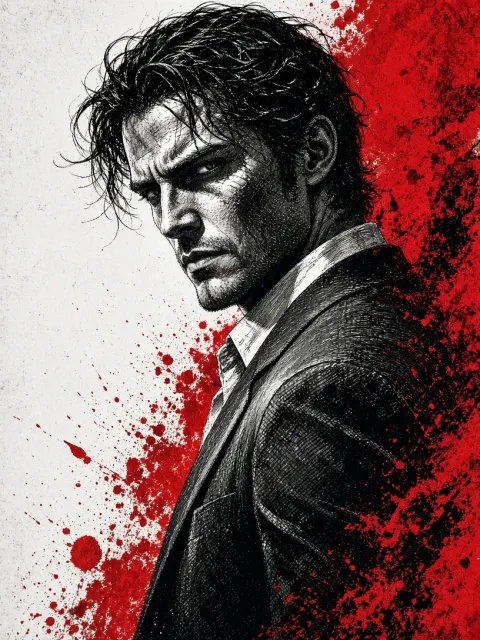
Create a high-detail, textured graphic-novel portrait, not vector and not a clean illustration. Use a chest-up composition with the subject filling approximately 75–80% of the frame, positioned slightly right, leaving clear empty space in the lower-left. Do not zoom in or crop tightly. Pose: The body faces left, with the back visible in profile. The left shoulder is closer to the camera. The head turns back over the left shoulder, looking directly at the viewer. Keep the face at approximately a 30–40° angle, not front-facing. Maintain strong shoulder depth; do not flatten the body. Expression: Intense, serious, and slightly intimidating, with a tight jaw, focused eyes, and compressed brows. Lighting: Use one hard light from the upper-left. Place bright highlights on the left forehead, cheekbone, and nose bridge, plus a narrow light strip on the front suit and lapel. Keep the right side of the face in deep, near-black shadow, with a sharp light/shadow boundary across the face. No soft light, even lighting, or ambient fill. Style: Textured ink rendering with slightly rough edges, visible grain and noise, and layered thick, thin, and micro linework. Render the subject entirely in black, white, and gray tones only; no skin color or natural color tones. Draw the hair with individually visible strands and messy directional flow. Avoid a smooth, clean, or vector-like finish. Shading: Use halftone only in shadow zones with a subtle grain overlay. No gradients or flat fills. Suit: Black tailored suit with visible folds and tension lines, a sharp shoulder crease, and a highlighted edge along the front. Avoid featureless flat-black areas. Shirt: white. Background: Do not use a straight split or centered division. The left side is very light gray, flat, clean, and minimally textured. The right side is rich saturated red. Make the transition look as though red paint has burst into the gray, with an irregular, broken, organic boundary, uneven paint edges, and slight bleed into the gray. Keep the gray area mostly clean, with only minor invasion near the boundary. Splatter: Add high-density layered splatter with large and medium irregular explosive shapes rather than circular forms, medium scattered drops, and clearly visible fine dust-like micro-particles. Use directional, non-uniform spray patterns, with greater density on the red side gradually reducing toward the gray. Mix red and black splatter, including subtle interaction along the subject’s back and shoulder edge. Avoid symmetry and repeated patterns. Avoid: front-facing pose, soft lighting, smooth gradients, vector style, flat shading, skin color, centered subject, clean vertical split. Compose for a portrait aspect ratio close to the requested 4:5 format.