Suggested canvas 3:4
Suggested model · Grok Imagine 2.0
English prompt
Full prompt
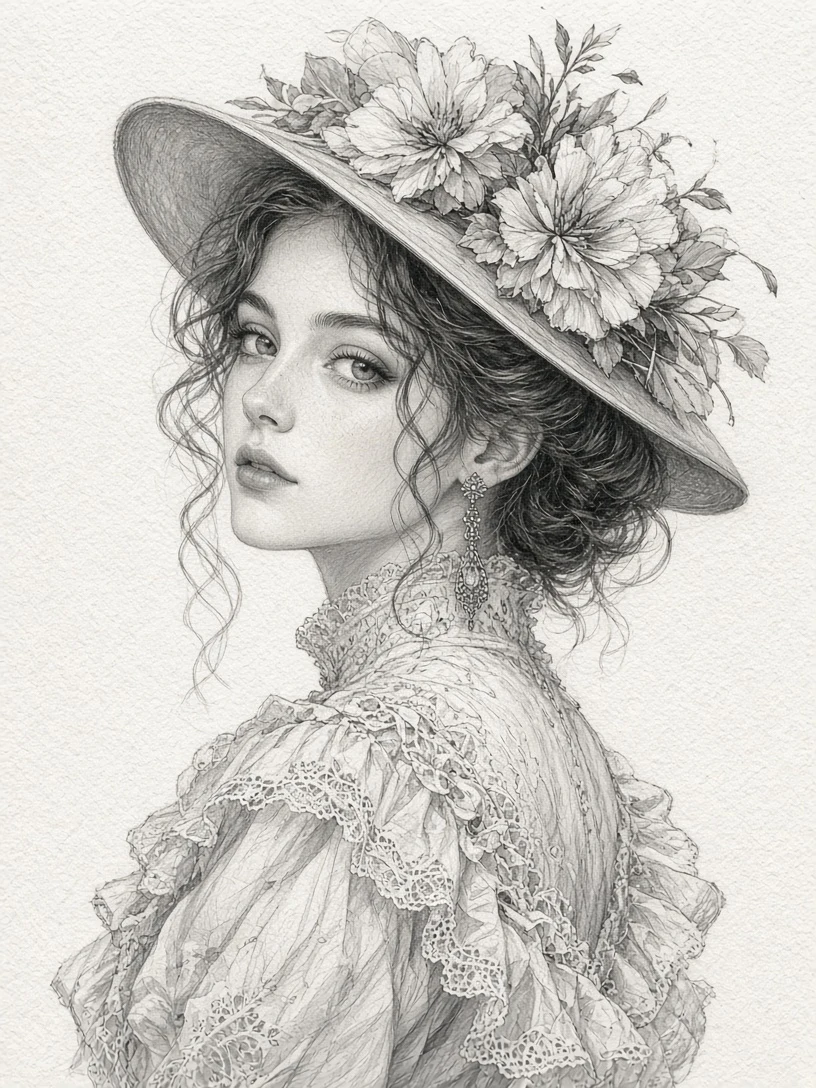
Create an ultra-detailed, soft graphite pencil portrait in a refined classical illustration style, as if drawn by a master traditional artist on high-quality textured paper. The artwork must feel entirely hand-crafted, with no digital or AI artifacts.
Subject:
A graceful woman in a vintage Victorian-inspired aesthetic. Delicate facial features, smooth natural skin shading, a soft natural expression, slightly parted lips, and calm, elegant eyes looking back over her shoulder.
Pose (LOCK):
Upper-body portrait, chest-up. Her body is turned away from the viewer by approximately 30–40°, with the back partially visible. Her head is turned back over her shoulder toward the viewer. Maintain a natural neck curve and dimensional shoulder depth; avoid a flat pose.
Styling and Details:
She wears an ornate wide-brim hat decorated with large soft flowers and subtle foliage. Her hair is styled in a loose, elegant low bun, with soft curled strands framing her face. Long, delicate drop earrings feature fine detailing.
Her outfit is a high-neck vintage blouse with intricate lace patterns, ruffles, and soft fabric folds. Render every fabric texture with high detail while keeping the overall softness.
Art Style (VERY IMPORTANT):
– Hyper-detailed graphite pencil shading
– Extremely soft gradients and smooth tonal transitions
– Fine linework with subtle pressure variation
– No harsh outlines and no cartoon feel
– Realistic skin shading using layered strokes
– Visible but refined pencil texture, with the paper grain slightly noticeable
– Create depth through light and shadow, not exaggerated contrast
Lighting:
Soft, diffused studio lighting from the front-left, creating gentle highlights on the face and smooth shadow transitions. No harsh shadows.
Background:
Clean, minimal light-gray paper background with subtle texture and no distractions.
Quality:
Extremely high detail and precise hand-drawn rendering. Every strand of hair, fabric fold, and ornament should feel carefully drawn.
3:4 aspect ratio.
Negative Prompt:
No digital painting look, no AI artifacts, no over-sharpening, no plastic skin, no exaggerated contrast, no modern styling, no color—strictly monochrome graphite.
Art Styles images and AI prompts, organized by subject and creative use.
Browsing and copying are free. Generation uses account credits with a quote before submission. Model, language and randomness affect output; exact reproduction is not guaranteed.
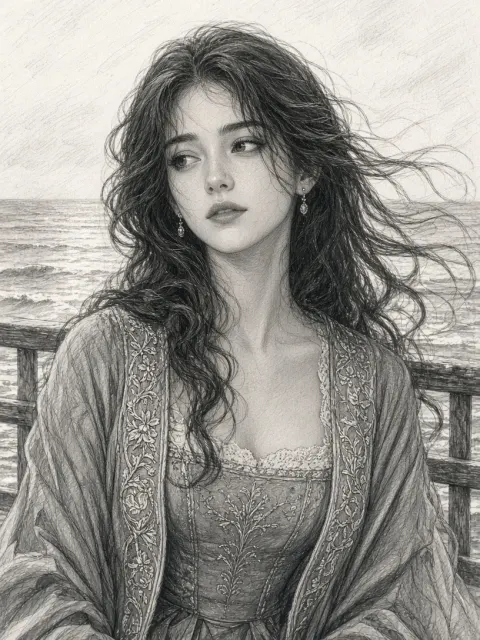
Create a 3:4 portrait composition featuring a highly detailed black-and-white graphite pencil portrait of a beautiful female subject standing near the ocean, shown from the chest up in a classic vintage style. She has soft expressive eyes gazing slightly off-camera, naturally arched eyebrows, defined lips slightly parted, and a calm, emotional expression that feels thoughtful, wistful, and quietly romantic. Her long, wavy hair is loose and windswept, with strands flowing across her forehead and outward in the sea breeze. She wears small, delicate drop earrings and a vintage period outfit: a softly draped embroidered outer garment with decorative floral trim along the edges, layered over a fitted dress with a square neckline, lace edging, subtle stitched floral detailing on the bodice, and gentle fabric folds.
The background shows a calm ocean horizon with gentle waves and a simple wooden railing behind her, softly sketched with horizontal pencil strokes. Use realistic graphite shading, fine cross-hatching, visible pencil texture, soft paper grain, detailed hair strokes, subtle facial shadows, natural skin shading, and hand-drawn sketch realism. Keep the composition centered with chest-up framing, a timeless romantic mood, and an elegant seaside atmosphere. Monochrome graphite only, no color, no digital painting look, no text, no watermark, no signature.
Use the uploaded image as the only facial and identity reference. Strictly match the subject’s facial structure, proportions, skin tone, and identity, with no beautification or alteration. Preserve natural skin texture and realism.
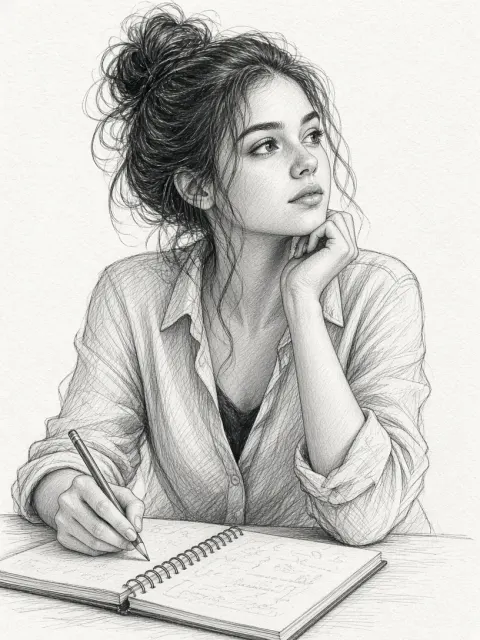
Create a refined black-and-white pencil-and-graphite sketch of the subject in a quiet, thoughtful moment, seated at a desk in a medium close-up, waist-up composition. The subject’s body is slightly angled to the right, with the head tilted upward and the gaze directed off-camera, conveying deep thought. One hand supports the chin; the other loosely holds a pencil while resting on a sketchbook. The pose should feel naturally paused rather than posed.
Render the face with sharp focus on the eyes, detailed irises and lashes, a calm, introspective, slightly distant expression, and softly parted lips. Style the hair in a soft, slightly messy high bun similar to the reference, with loose stray strands around the face and neck for a natural, realistic appearance.
The subject wears a light button-down shirt with rolled sleeves over a darker inner top. Show detailed fabric folds with expressive sketch lines, especially around the elbows and arms. Use a highly refined graphite drawing style with precise line work, variable line weight, detailed hatching and cross-hatching for shadows, soft graphite blending for skin values, and visible pencil strokes that create texture and depth. Maintain realistic hand anatomy and fabric structure.
Use a soft top-left light source, creating gentle shadows on the right side of the face, beneath the chin, and across the arms. Keep the background minimal and clean white with subtle paper texture and no distractions, creating a strong sketchbook aesthetic.
No color, no digital-painting appearance, no blur, no warm tone, no low-detail rendering, no cartoonish style, and no extra hands. The result must feel like a high-end, realistic hand-drawn graphite sketch. Compose for a portrait-oriented frame approximating the requested 4:5 format.
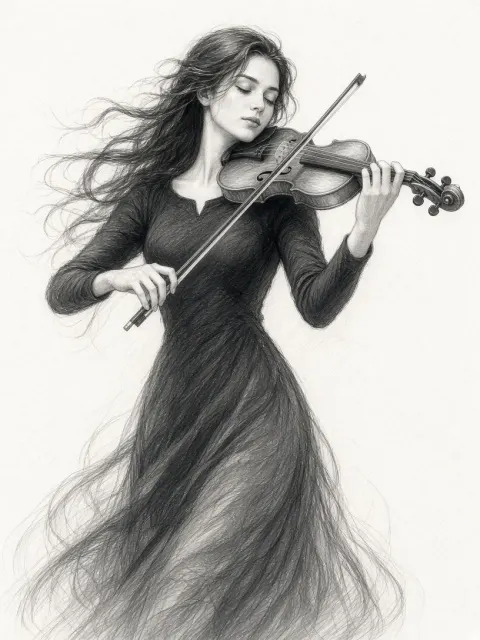
Create a highly skilled graphite pencil drawing of the reference woman playing the violin, combining realistic anatomy with controlled, expressive sketch rendering. The work should feel made by an experienced artist: composed, confident strokes that are loose in selected areas but always intentional and refined, never messy or amateur.
Composition: vertical portrait framing from the upper thighs to the head, centered against a clean white background. Use a portrait proportion close to 4:5.
Expression and mood: eyes closed, calm and emotionally immersed, with a subtle, non-dramatic expression and no smile.
Outfit: a one-piece skirt dress. The top should have dense, rich graphite shading, forming a nearly solid dark mass. The skirt should use loose but controlled strokes that suggest motion without chaos.
Linework and rendering: flowing hair rendered with dynamic strokes that have clear direction and rhythm, never random scribbles. Render the face and skin with smooth tonal shading and minimal visible strokes, creating a soft blended feel. Keep all lines confident, purposeful, and steady rather than shaky.
Anatomy and pose: a natural, slightly asymmetrical pose; realistic, cleanly drawn hands; and a natural, elegant bow angle.
Violin details: clean, precise structure, fine straight strings, and subtle highlights created through tonal contrast rather than rough marks.
Lighting: soft directional light from the upper left, with gentle shadows and smooth transitions.
Negative constraints: no messy scribbles, no rough amateur sketch look, no harsh cross-hatching on the face, and no overly polished digital rendering. Style: fine-art graphite, controlled sketch, composed strokes, classical drawing, realistic anatomy, elegant rendering.
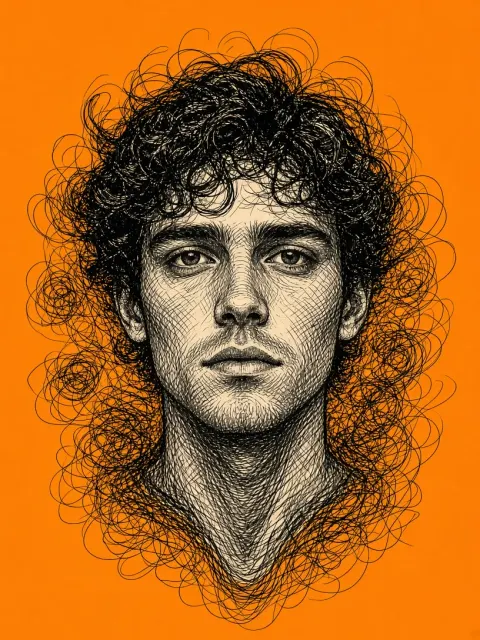
Create a highly detailed head-and-neck portrait illustration of a person using the provided face reference. Preserve the exact facial proportions, identity, and unique features without alteration.
Composition: Include only the head and neck in a tightly composed, perfectly centered frame, with balanced negative space around the head and hair. The subject looks directly into the camera from a strict eye-level, front-facing angle with no tilt. The expression is calm, composed, and neutral.
Art style: Render the artwork as a raw, chaotic ink-style poster constructed primarily from dense, curved black scribble strokes. Use the reference strictly for accurate structure and likeness; do not stylize the face beyond recognition.
Line work and form: Build the hair, facial shadows, and depth with layered, overlapping, uneven lines and rough cross-hatching. Keep the lines organic, tangled, expressive, slightly imperfect, and full of controlled hand-drawn energy. Introduce slight asymmetry in the line flow while maintaining structural clarity. Surround the subject with an irregular, abstract, tangled aura of loose scribbles.
Color palette: Use only a flat beige tone for the skin and deep black ink strokes for structure and shading. Do not use gradients, smooth blending, or realistic rendering.
Background and lighting: Use a solid, flat, vibrant orange background that is clean and uniform, creating strong contrast with the black ink work. Imply lighting only through line density; do not use realistic lighting or shading techniques.
Overall look: High-contrast, graphic, poster-like expressive ink illustration with a raw sketch and abstract line-art aesthetic.
Strictly avoid: Any visible outfit, 3D effects, realistic rendering, gradients, soft shading, polished rendering, or a clean digital finish.
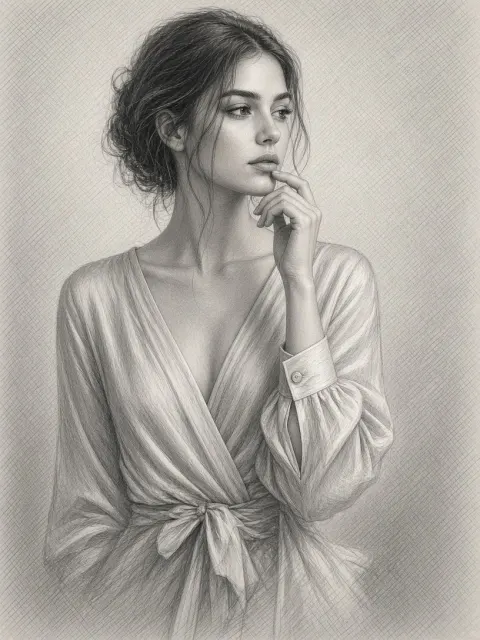
Create an ultra-realistic fine-art graphite pencil portrait of the woman in the provided reference image, matching her identity and facial features exactly. Preserve her facial structure and proportions, bone structure and jawline, eye shape and spacing, nose structure, lip shape and fullness, graphite interpretation of skin tone, hairstyle, hairline, and parting. Do not beautify, stylize, or alter her features; the drawing must clearly resemble the same person.
Use a vertical mid-torso, waist-up composition showing the upper body down to the blouse’s tied waistline. Position her slightly off-center with open negative space in the direction of her gaze. Her torso angles slightly left, shoulders remain relaxed, and her head turns gently right. She gazes softly off-camera to the right with a distant, contemplative expression. Place the head in the upper third, with blouse folds and the raised arm guiding the eye toward the face.
Her right hand is raised thoughtfully toward her face, with the wrist elegantly bent, index finger resting lightly against the lower lip, thumb beneath the chin, and remaining fingers softly curled inward. Render anatomically correct structure, visible knuckles, natural fingernails, and delicate finger proportions. The gesture should feel relaxed and introspective.
Render smooth high cheekbones, a delicate well-defined nose, a sculpted jawline, and full lips softly shaded with darker graphite at the center parting. Include highly detailed eyes with subtle eyelid shading, long eyelashes, and thick naturally arched eyebrows. Use seamless graphite blending and ultra-smooth tonal gradients for the skin.
Her dark natural hair is loosely styled in a relaxed, slightly messy low bun or gathered style at the back. Add fine pencil strands, soft natural volume, loose strands around the temples and forehead, wispy strands framing the ear, and one thin strand falling vertically across the left cheek. Use layered graphite strokes for realistic hair texture and depth.
She wears an elegant wrap-style V-neck blouse in soft, flowing silk- or satin-like fabric. Include an overlapping wrap front forming a deep V neckline, a fabric belt or tie cinching the waist, soft draping folds radiating from the waist knot, and fluid fabric tension across the torso. The long, slightly loose sleeves have gathered volume along the forearm and deep natural folds at the inner elbow from the raised arm pose. Add structured cuffs with clean tailored edges, a single round button, and a vertical slit placket beside each button. Show realistic fabric weight, smooth highlights, and natural tension lines.
Set the portrait on textured fine-art drawing paper with very subtle diagonal cross-hatching running from top right to bottom left and soft vignette shading toward the edges. Use soft diffused white studio lighting, gentle shadow transitions, realistic modeling across facial planes, and natural graphite value contrast, with subtle shadows under the chin, fingers, and blouse folds. Render a monochrome black-and-white graphite drawing with hyper-detailed pencil work, classical fine-art realism, precise linework, controlled cross-hatching, and subtle paper grain. Gradually dissolve the lower portion into the paper surface with a soft graphite fade, creating an unfinished fine-art effect. Maintain a romantic, melancholic mood and a vertical portrait composition.
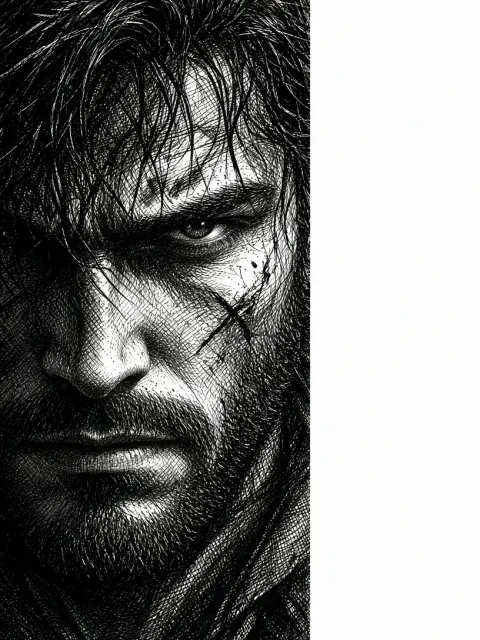
Hyper-realistic dramatic black-and-white neo-noir assassin portrait rendered as an ultra-detailed ink engraving with dense cross-hatching. Vertical portrait composition, with the subject positioned on the left edge and occupying approximately 60–65% of the canvas; preserve the right 35–40% as clean white negative space. Show approximately two-thirds of the face, vertically cropped through the center of the eye. Use a tight cinematic close-up: crop slightly into the hair at the top and just above the upper shoulder at the bottom. The face is almost directly toward the viewer with a slight forward angle, and the intense eyes are the primary focal point.
Use the uploaded image as reference for the hairstyle and facial hair. Rebuild the hairstyle with natural thickness, layered texture, dark color, high-volume messy movement, a large side-swept shape, a slightly wet appearance, and meticulously rendered individual strands. Include loose strands falling naturally across the forehead; avoid thin, short, simplified, or overly groomed hair. Convert the reference facial hair into a rugged assassin beard: add light rugged stubble if clean-shaven, make existing stubble short and dense, or intensify an existing beard with greater density and texture. Show visible hair strokes, cross-hatched beard shadows, a strongly defined jawline, and natural, raw, masculine thickness rather than a perfectly groomed finish.
Add subtle light scars, scratches, ink-splatter marks, and rough skin texture. Render all skin shading with dense cross-hatching instead of smooth gradients. Use extreme noir chiaroscuro lighting: one side of the face falls into deep shadow while the other is strongly illuminated, with shadows formed by dense ink hatching and very high contrast. Emphasize visible cross-hatching, ink scratches, line textures, and rough engraving strokes inspired by noir graphic novels, vintage engraving art, and crime-thriller posters. Keep the background pure, clean white with expansive negative space. Dark, brutal, cinematic mood; intense, dangerous expression. No color, no clutter in the negative space, no smooth digital gradients, no polished or friendly styling.

 Generated with Grok