 Generated with Grok
Race Day Stride
Action · Fitness & Gym · Health & Wellness · Sports & Athletics
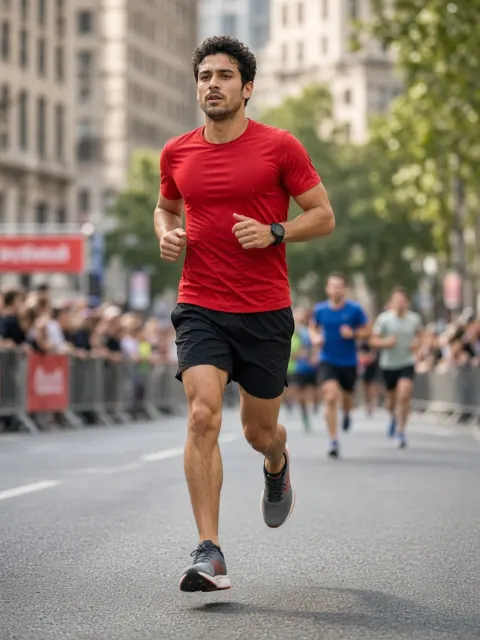
Use the uploaded reference image as the primary identity source. The runner must match the same person exactly, preserving precise facial structure, skull shape, jawline, cheekbones, eye shape, nose shape, lip shape, eyebrow thickness, hairline, hairstyle, skin tone, facial hair pattern, natural asymmetry, skin texture, facial geometry, and overall anatomical proportions. Maintain true identity fidelity and likeness without beautifying, stylizing, or altering facial features; the person must remain clearly recognizable. Create a hyper-realistic professional sports photograph of the subject running at the front of a marathon or road race on a wide metropolitan city street. Portrait orientation with a 4:5 composition. The subject is captured mid-stride in the airborne flight phase: one leg driving forward with proper anatomical running form, the opposite leg extended behind, arms bent at approximately 90 degrees close to the torso, hands relaxed, and an upright, balanced posture showing efficient athletic motion. Keep the face perfectly sharp and clearly visible, with a focused, determined, forward-looking expression. The subject wears a modern, form-fitting red athletic performance T-shirt with realistic fabric tension and compression folds, lightweight running shorts with natural movement, and professional running shoes with realistic structure and cushioning. An optional sports watch or fitness tracker may be present. Clothing should look authentic, modern, and performance-oriented. Set the scene on a wide metropolitan boulevard or city race route, with modern or classical urban buildings and trees lining the street. Place spectators behind race barriers and secondary runners behind the subject, progressively blurred to create depth. Show a clean asphalt road surface with realistic texture. Use bright natural daylight with soft directional sunlight from a side or front-side angle, realistic shadows beneath the subject, natural skin tones, and accurate highlight-to-shadow transitions. Avoid dramatic cinematic lighting; maintain realistic outdoor race illumination. Photograph with a full-frame camera and an 85mm lens or similar telephoto compression, using a shallow depth of field around f/2.8–f/4. Keep the subject in razor-sharp focus while the background has smooth, natural bokeh. Capture realistic athletic motion with high dynamic range. Ensure anatomically correct limbs, joints, hands, feet, and running form. No distorted anatomy, extra limbs, artifacts, unnatural motion blur on the face, cartoon styling, artificial appearance, or facial identity changes. Hyper-realistic professional sports photography, marathon runner, daylight, athletic realism, identity match, shallow depth of field, realistic motion capture, natural lighting, photorealistic.